 |
| A mini RC helicopter |
Thanks to its hover feature, one helicopter can be used in many situations and distant places where it is not accessible by land vehicles. Things like saving injured personnel at a cliff, or searching a person in a wide range of field like open water requires the capability of helicopters which can hover for a very long time. The drawback of helicopters is the flying speed. On the vertical view, helicopter is very fast, far faster than airplanes. It can take off within less a minute, compared to airplanes which may need two or three minutes. However, the terminal speed of helicopters is slower than most of airplanes. Helicopters just cannot be supersonic, a modern standard required for most of fighters. Still, helicopters maintain their own glory for the unique feature that no one can reach.
The important components on helicopters must be the blades and the tail rotors. Most people may not think that much on how helicopters make their movement. They may think the blades are rotating so it just flies! But hey, how do helicopters move forward? What is the mechanism behind this? The following will introduce a component that I think is really important and revolutionary for the development of helicopters.

The lower blue part is called swashplate.
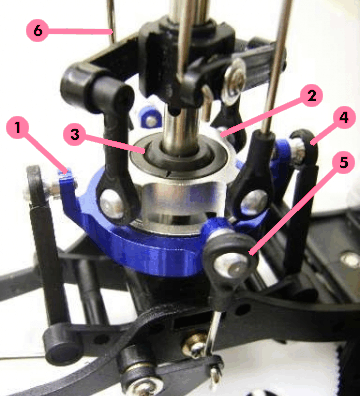 |
| 1 Non-rotating outer ring (blue) 2 Turning inner ring (silver) 3 Ball joint 4 Control (pitch) preventing turning of outer ring 5 Control (roll) 6 Linkages (silver) to the rotor blades |
 |
| A lucid demonstration of swashplate |
 |
| A swashplate that tilt to a specific angle. You can see how the linkage is affected by the lower part of the plate. |
 |
| You see the angle of the entire blades is 30 degree to the right. |
 |
| The blades is now tilted to the upper left. |

No comments:
Post a Comment